
RatssTech is, at heart, a research and engineering company. Our shipping products — AeroClip Summit, Balmoral Marker, AeroTorq, AeroScout, the RTK Tower — are the visible tip of a much wider R&D programme that quietly runs underneath the business.
Behind every field-ready system is a stack of experimental airframes that exist to ask one question: what’s possible if we stop accepting the default shape of a drone?
The UAV is locomotion. The payload is the robot.
A quadcopter is not the goal. It’s a way of moving a payload through three-dimensional space. The interesting question is always what the payload does once it gets there.
That mental model shapes how we build:
- Standard quadcopters are great when the job is go there and look. Locomotion is the whole task.
- Aerial robotic systems need the airframe to be subordinate to the work — orientation, force, dwell time, decoupled motion, contact stability. The shape of the aircraft is determined by the shape of the mission.
When the mission changes, the airframe should change with it. That’s why we keep building unconventional platforms.
What we’re exploring
A non-exhaustive snapshot of what’s currently on the bench:
- Omnicopter configurations — tilted-rotor or fully-actuated layouts that decouple translation from attitude. The aircraft can push, pull, hold a yaw, or apply a sideways force without tilting itself.
- 6DOF platforms — full six-degree-of-freedom control for tasks that need the body fixed in space while a payload acts independently: inspection, contact-based sensing, fastener engagement, surface interaction.
- Unique payload-driven geometries — frames designed around the tool, not the other way around. Conductor-mounted installers, top-mounted payloads, asymmetric arm layouts, ducted configurations for confined environments.
- Structural coupling experiments — understanding how a payload’s reaction forces feed back into the airframe, and how to engineer that loop so the controller doesn’t have to fight it.
Some of these will become products. Some will quietly inform the next generation of an existing platform. A few will be dead ends — which is fine; dead ends are how you find the live ones.
Why this matters for clients
If you’ve ever brought us a problem and heard “that’s not quite what our standard platform does — but here’s what we could build”, this is why. The experimental work means we don’t only see drone problems through the lens of which quadcopter do we buy.
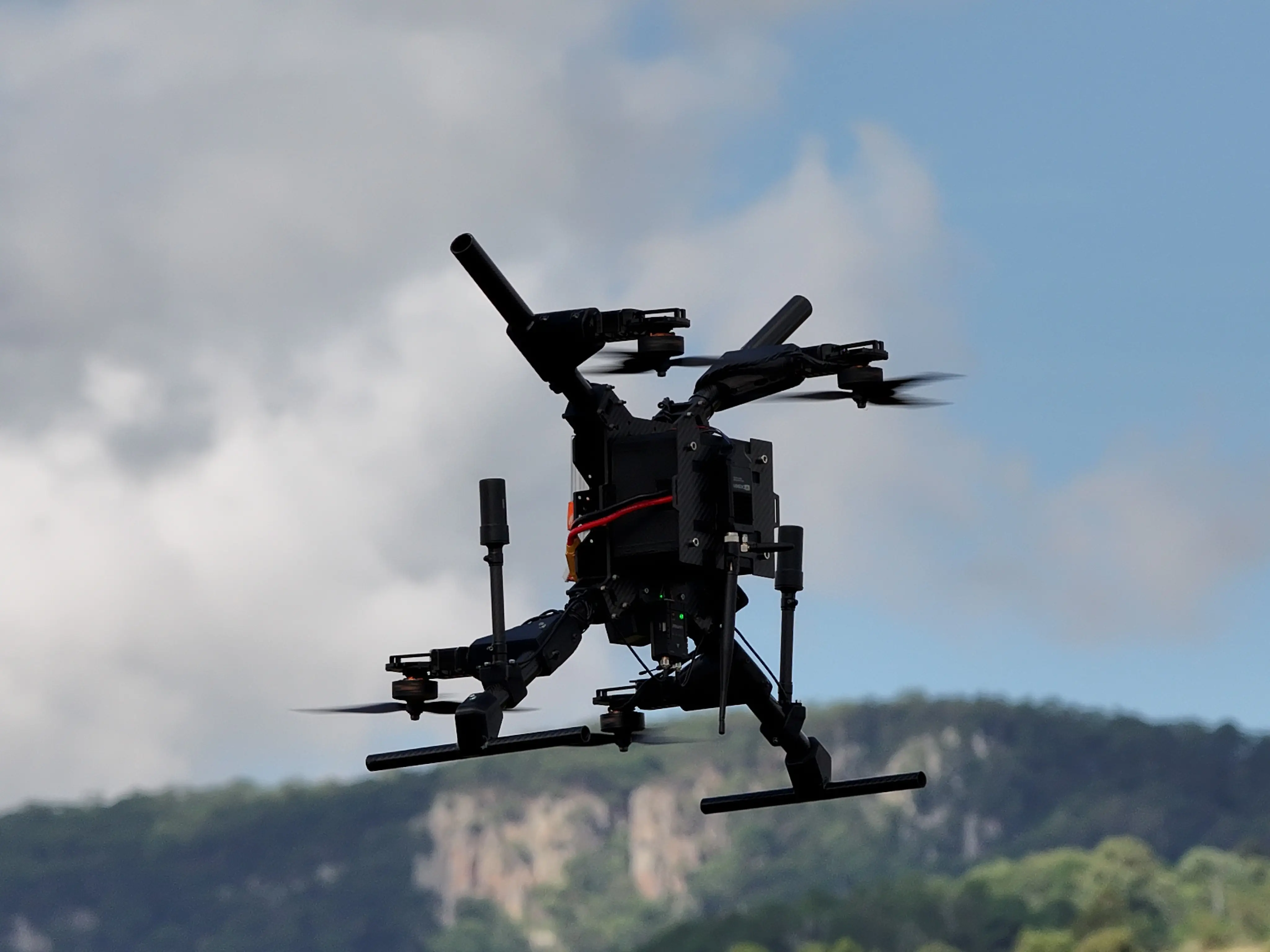
The airframe pictured here is one of those development articles. Not a product, not for sale — a piece of the R&D thread that connects last year’s prototypes to next year’s shipping systems.
We’ll keep publishing field notes from the bench as the work evolves.