
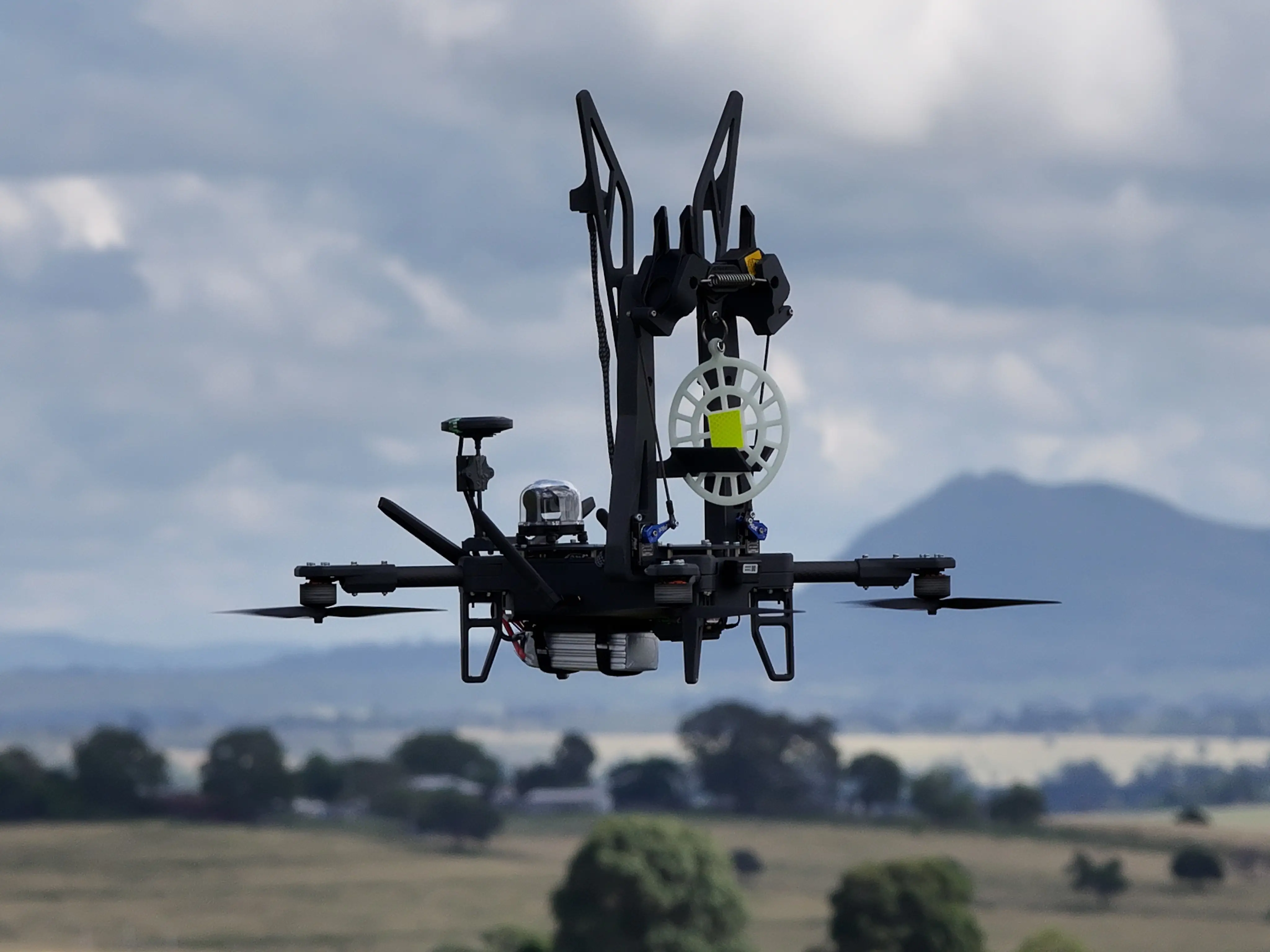
For most of the last decade, commercial drone work meant one thing: a sensor on a stick. The aircraft’s job was to look at something and bring back data.
That era isn’t over, but it’s no longer the leading edge. The leading edge is aerial robotics — purpose-built flying machines that physically interact with the infrastructure they were sent to. Install a marker. Torque a fitting. Place a sensor. It’s a substantially harder problem — and it’s where Australia’s critical-infrastructure sector is heading.
Why Australia, specifically
A few things push the transition harder here than almost anywhere else:
- Distance. A 700 km transmission corridor through low-population country is a routine Australian asset. Sending a helicopter to every point, every year, is brutal economics.
- Workforce. Live-line workers are a finite, highly trained, well-compensated group. Anything that lets a smaller crew do more — safely — has immediate value.
- Weather windows. Cyclone recovery, post-fire reinspection, flood-impacted assets. Australia has a steady drumbeat of “we need this looked at now” events.
- Regulatory support. CASA’s Part 101 / ReOC framework gives a clear path to operating heavier platforms beyond visual line of sight.
Most countries have one or two of these. Australia has all three, plus a regulator broadly supportive of solving them with technology.
Drone vs robot
The mental shift matters. A drone carries a sensor. A robot performs work. The engineering implications are very different:
- Force matters. A camera weighs what it weighs. A torque installer has to deliver torque against a real fitting, in air, while the airframe holds station.
- Precision is non-negotiable. A 3 m error smears a survey slightly; the same error on an install mission misses the conductor entirely.
- Missions are staged. Survey is one big sortie. Install is dozens of approach–engage–install–exit cycles, each with its own abort criteria.
- Serviceability moves up front. A field robot has to be repairable from a ute with a sensible spares kit.
- The pilot’s job changes. Less flying the drone, more flight-engineer — commanding a system, monitoring a pipeline, exercising authority at gated transitions.
This is what we mean when we say RatssTech does aerial robotics rather than drone services.
What we expect next
Three things look durable from where we sit.
Purpose-built beats configured
The buy a generic platform, bolt on a payload, hope it works era is closing for serious infrastructure missions. Control loops, structural design, failure modes, and the install pipeline want to be co-designed.
The pipeline matters more than the airframe
The most underestimated piece of any aerial-robotics deployment is the wrap — mission planning, work-pack generation, pilot tooling, install logging, asset-database integration. The drone is maybe 10% of the value; the workflow around it is the rest.
Local manufacture becomes a procurement requirement
For critical-infrastructure clients, designed and manufactured in Australia is moving from marketing line to procurement requirement. Supply chain resilience, in-country support, IP protection and sovereignty all point the same way.
What stays the same
The operating philosophy doesn’t change. The aircraft serves the mission. The pilot has authority. The engineering survives Queensland sun, central-Australian dust, and Tasmanian wind. The test of every new generation is the same: did it solve the problem the client walked in the door with?
That’s the bar. Everything else is just airframes.