
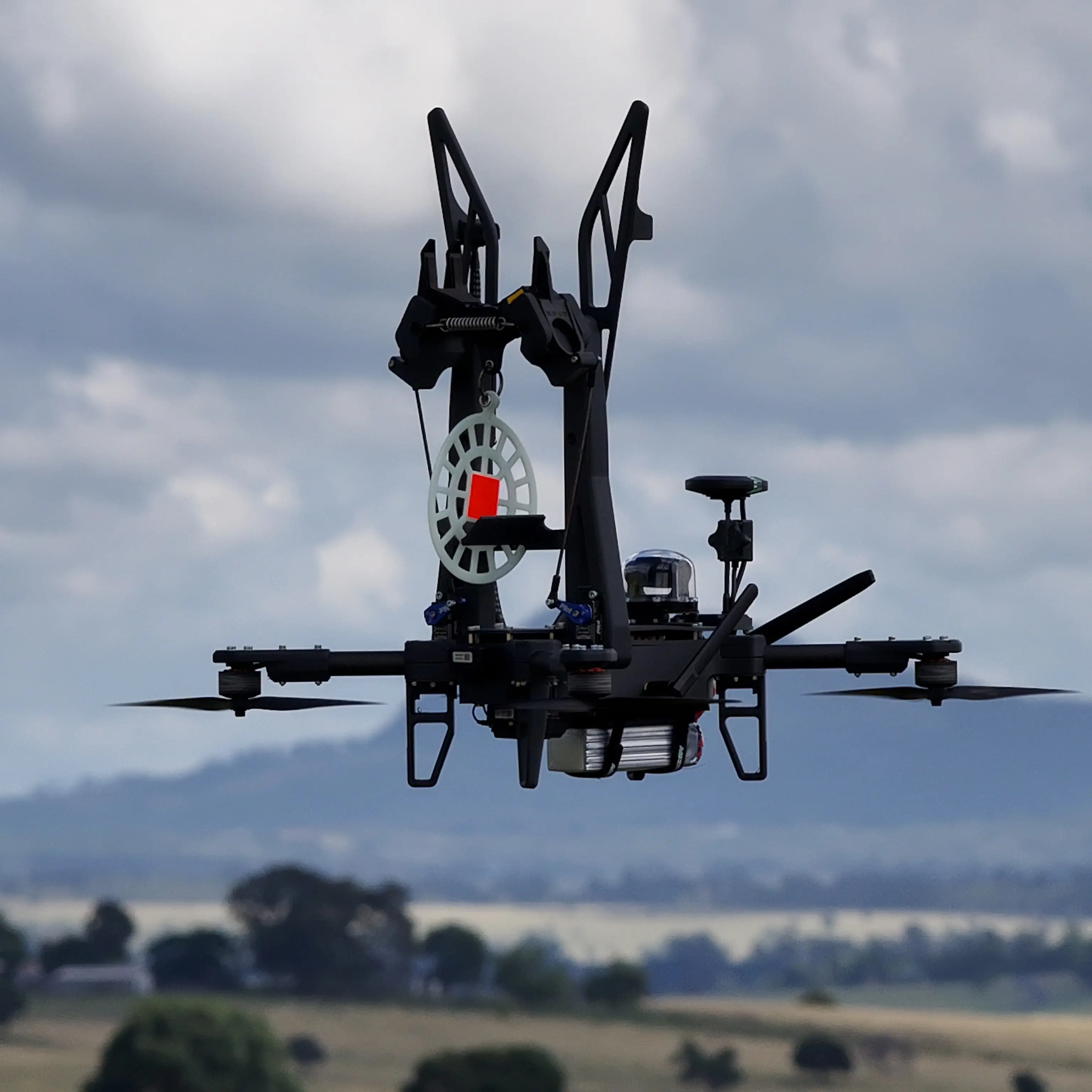
Installing a marker or diverter on a high-voltage conductor has always been expensive and risky. Helicopters cost a fortune per hour. Outages cost the grid more. Climbers put crews at height.
AeroClip exists to make all three obsolete.
One platform, two configurations
AeroClip is a single platform refined across seven airframe generations — one system, continuously iterated. It ships in two field configurations:
- Summit Installer — flagship, for full conductor-mounted device installs on energised lines.
- Balmoral Marker — lighter sibling, optimised for diverter and marker work.
Both share the same DNA: a unitary airframe-plus-payload, RTK positioning, and a semi-autonomous install pipeline with the pilot firmly in the loop.
Semi-autonomous — pilot in the loop
We use semi deliberately. Energised transmission infrastructure is no place for “trust the algorithm”. The pipeline runs as eight gated stages:
- Map — survey the span, model the conductor geometry.
- Detect — locate the conductor in real time on approach.
- Align — match airframe orientation at a known standoff.
- Approach — close the standoff under tight position control.
- Dock — engage the installer payload.
- Install — actuate the device onto the line.
- Exit — disengage cleanly and retreat.
- RTB — return to launch for the next device.
The pilot has authority to hold or abort at every transition. No “press go and walk away” mode — and no plan to add one.
What changes for operators
- No outages. Avoiding even one on a marker program often pays for the deployment.
- No helicopter charter. Save rotary-wing time for jobs that actually need it.
- Scales by sortie, not crew. More throughput means more battery turnarounds, not more line workers in PPE.
- Documentation is free. Every install ships with GPS-tagged photos, a flight log, and a clean asset-database update.
What’s next
The Summit Installer’s first field-ready unit is operational in 2026. The roadmap is more of the same drone, refined — tighter actuator feedback, broader voltage envelopes, better crosswind handling.
If your team runs a marker, diverter, spacer, or conductor-mounted device program, we want to hear about it.